



Why Cheap Floor Mats Become a Safety Risk Over Time
The problem starts with fit, and it starts earlier than most drivers expect.
Most low-cost floor mats are built around a universal template—a generalized shape designed to fit across dozens of different vehicle interiors rather than one specific floor pan. That approach creates small but critical inconsistencies, including uneven edges, partial coverage, and sections where the mat never fully contacts the underlying surface.
Without full-surface contact, the mat never truly settles into the footwell. Instead of sitting flat and stable, it rests unevenly, leaving room for subtle movement every time pressure is applied.
OEM floor mats and high-quality aftermarket liners solve this by following the exact contours of the vehicle’s floor using laser-measured designs. They also integrate retention clips or anchor systems that physically lock the mat into place. Universal mats lack both contour accuracy and retention, which means instability isn’t a defect—it’s part of how they function.
How Movement Turns Into a Real Safety Issue

Once a mat begins to shift, the movement usually doesn’t correct itself—especially without proper anchoring—and can gradually get worse over time.
Everyday driving introduces repeated forward pressure through braking, acceleration, and constant foot repositioning. Each movement is subtle enough to go unnoticed, but the direction of force remains consistent, gradually pushing the mat closer toward the pedal area.
Over time, this slow displacement can turn a minor fitment issue into a real safety concern. As the mat creeps forward into the pedal zone, even a slight overlap can start to interfere with normal pedal operation:
-
Alters original pedal travel distance.
-
Reduces brake and accelerator return speed.
-
Creates physical resistance during quick transitions between pedals.
That loss of consistency directly affects braking precision. In situations that require immediate response—such as sudden stops or evasive maneuvers—any delay or obstruction in pedal movement introduces measurable risk.
Properly engineered mats prevent this entirely by anchoring into fixed points on the floor. Loose mats, by contrast, rely entirely on surface friction, and once that friction is compromised, there is nothing to stop continued movement.
=> Read More: How to Choose Anti-Slip Car Floor Mats
Material Quality Becomes a Separate Problem

Fitment and stability define how a mat behaves physically, but material quality determines how it holds up under real-world conditions.
Low-cost mats are commonly produced from recycled rubber or lower-grade PVC compounds that lack thermal stability. Inside a parked vehicle, especially under direct sunlight, cabin temperatures rise rapidly and regularly exceed 60°C. Under those conditions, weaker materials can start to break down under prolonged heat exposure.
This degradation can lead to off-gassing —the release of volatile organic compounds (VOCs). In an enclosed space, these emissions can accumulate, especially in poorly ventilated vehicles.
Over time, this outgassing measurably degrades overall cabin air quality, leaving persistent chemical odors and airborne VOC residue trapped within the interior space. While gradual, repeated exposure compounds its effects over the lifespan of the mat.
Higher-quality materials, such as TPE (Thermoplastic Elastomer), are engineered to remain stable under heat, maintaining both structural integrity and chemical consistency even under prolonged exposure.
Where Wear Turns Into Functional Failure
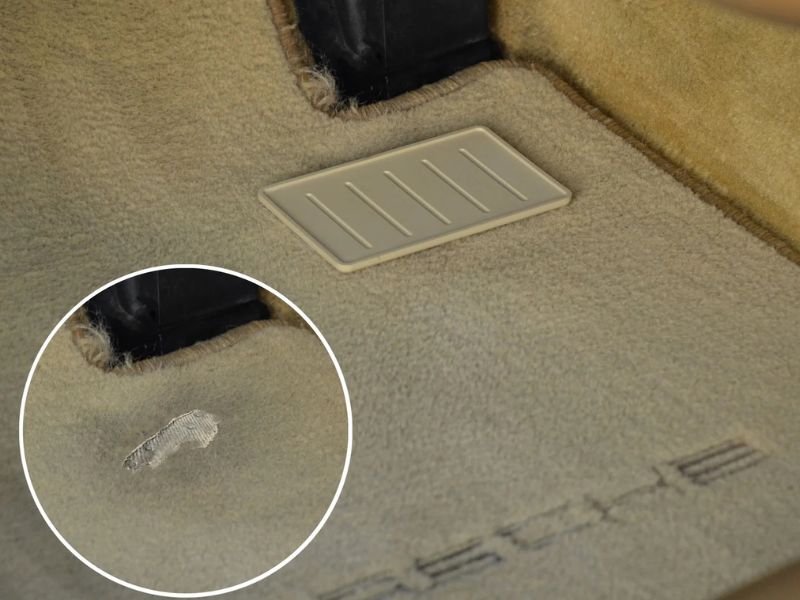
Wear inside the cabin doesn’t occur evenly—it concentrates at specific pressure points, specifically at the driver’s heel position.
This single area absorbs repeated force every time the vehicle is driven, creating a constant cycle of compression and friction against the mat’s surface. Premium materials are designed to absorb and distribute this stress, maintaining thickness and elasticity over time.
Lower-density materials behave differently:
-
Under repeated pressure, they begin to compress permanently.
-
The surface gradually thins out and loses structure.
-
The material can eventually wear through, exposing the factory carpet.
At that point, the mat may no longer function effectively as a protective barrier. Debris, sand, and fine particles pass through the damaged area, creating abrasive wear that leads to permanent deterioration of the interior surface.
Just as importantly, once structural integrity is compromised, the mat becomes more flexible and less stable. That instability feeds back into the same movement cycle that leads toward pedal interference.
Why Moisture Control Matters More Than It Looks
Liquid exposure follows a similar pattern but introduces an additional layer of instability.
Basic mats are typically flat or shallow in design, lacking the deep channels and raised edges required to contain water effectively. When liquid enters the mat, it spreads across the surface. During normal driving, that liquid moves freely and escapes beyond the edges into the surrounding carpet.
Once moisture reaches the underside, it becomes trapped. With limited airflow, evaporation slows significantly. This typically leads to two issues:
-
Material Degradation: Accelerates odor buildup and the long-term breakdown of the mat beneath the surface.
-
Loss of Friction (Safety Risk): A damp underside can reduce friction against the factory carpet. This can make forward slipping toward the pedals more likely, reinforcing the cycle of displacement.
Why Better Mats Perform Differently
A well-designed floor mat maintains its position, structure, and containment capabilities over time. Laser-measured liners match the exact geometry of the vehicle’s floor, eliminating gaps. Retention systems physically anchor the mat in place, preventing forward movement even under repeated pressure.
This level of predictability matters most in the driver’s footwell. When the surface underfoot remains fixed and reliable, pedal operation stays consistent. There are no shifts, no obstructions, and no delays introduced into braking or acceleration.
Lower-quality floor mats often fail over time due to limitations in fitment, material stability, and structural design. This kind of failure doesn’t happen all at once; it develops gradually until it reaches the point where it starts to affect how the vehicle responds in real-world use.
A quick visual check of the driver-side footwell can identify whether a mat is still safely anchored. Mats that fail to utilize factory retention clips or show signs of forward creep present an immediate interference risk to the pedal box. When replacement becomes necessary, exploring the differences between custom-fit and universal liners is the most effective way to eliminate these interference risks.
Other articles

Custom Fit vs Universal Car Floor Mats: Which One Should You Choose?

How to Clean Carpet Car Floor Mats (Step-by-Step Guide)

What SGS Testing, RoHS 2, and REACH Mean for Car Floor Mats



